September 21, 2026
Category:
Pay TransparencyAuthor:
Adam Seoudi
/
Head of CX
Having managed compensation across Asia, Europe and the Americas, including operational responsibility for pay processes covering tens of thousands of employees, I have learned that the most difficult part of pay transparency is rarely the formula.
The real challenge is turning payroll data, job architecture and distributed pay decisions into an answer that is accurate, safe, explainable and delivered on time, every single time.
This is exactly the challenge created by the employee right to pay information under the EU Pay Transparency Directive. On paper, the requirement can be summarised in one sentence: an employee asks how their pay compares with people doing the same work or work of equal value, and the employer provides the answer.
In practice, that answer may require data from payroll, HRIS, time and attendance, job evaluation and performance systems. It may need input from Reward, Payroll, HR Operations, HRBPs, managers, Legal, Data Privacy and employee representatives. It must follow different national rules, avoid revealing another person's pay and still reach the employee within a statutory deadline.
So, can it be automated safely?
Yes, but only if we automate the whole controlled process, not just the final document.
What the Directive actually requires
Article 7 of Directive (EU) 2023/970 gives workers the right to request and receive, in writing:
information about their individual pay level; and the average pay levels, broken down by sex, for the category of workers performing the same work or work of equal value.
Under the Directive's baseline, the employer must provide the information within two months. Workers may make the request personally or through employee representatives or an equality body. If the information is inaccurate or incomplete, they can request additional and reasoned clarification.
Employers must also inform all workers, at least once a year, that this right exists and explain how to exercise it.
Two details are particularly important.
First, the annual reminder is not an annual limit on requests. The Directive itself does not say that a worker may ask only once per year.
Second, transparency does not override confidentiality. If the information would directly or indirectly reveal the pay of an identifiable worker, Member States may require access to be limited to employee representatives, a labour inspectorate or an equality body.
This creates a legal obligation and a privacy gate at the same time. A compliant process must be able to produce the required comparison, but it must also know when that comparison cannot be released directly to the employee.
One Directive, already different national processes
The countries that have implemented the Directive show how quickly one European principle can become several operational models.
Italy
Written response within two months
The right may be exercised only once per year. Employers may also make category-level averages available through an intranet or a restricted area of the company website. Italy defines pay level through gross annual and corresponding gross hourly pay, focused on continuous and fixed elements and excluding certain individual, non-structural, discretionary or temporary components.
Slovakia
Written response within two months, with a further 30 days for additional and reasoned explanation
The employee receives their own pay level and sex-disaggregated averages for the relevant category. The information must not be given in a form that would identify another worker's pay. Slovak law defines pay level by reference to calendar-year remuneration and the corresponding hourly remuneration.
Malta
The initial employer deadline is only eight days
If the employer does not respond, a representative may make a further request after the initial deadline. Failure to provide the information within 45 days from the original request can become a criminal offence. For requests made in 2026, the information may be limited to pay relating to 2026. Sensitive cases are routed through representatives or the relevant bodies.
Lithuania
The transposing law has been adopted, with the employee information right and the new monthly data flow scheduled from 1 January 2027
Employees will be able to request information at any time about their own pay and the average annual and hourly pay, by sex, in the same job group. Lithuania is building a centralised model in which employers submit monthly pay and working-time data to Sodra, which calculates and returns relevant indicators. Sensitive comparisons are routed through employee representatives, the State Labour Inspectorate or the equality body.
The differences are not cosmetic. They affect system design.
A global employer may need an eight-day deadline in Malta and a two-month deadline in Italy or Slovakia. It may need to allow repeated requests in one country but block a second request in the same year in Italy. It may be able to release a result directly in one case but have to route the same type of comparison through a representative or authority in another.
The reference period may differ too. Some regimes anchor calculations to a calendar year or to a completed previous year. Other approaches are rolling. Poland's current draft, for example, uses the 12 months for which remuneration was paid before the month of the request. Malta has a specific transitional approach for 2026. Lithuania is building annual and hourly indicators from a recurring monthly data flow.
The Directive creates a common right. National law determines how that right operates. For a multi-country employer, configurability is therefore not a product preference. It is a compliance requirement.
Why the answer will usually come from payroll
There is a fundamental difference between contractual pay and actual pay.
Contractual data tell us how the reward system was designed. They show base salary, target bonus, contractual allowances, grade, range and other policy-driven elements. These data are relatively stable and are often the best starting point for analysing whether pay decisions are consistent.
Payroll data tell us what actually happened.
They contain salary payments, overtime, shift premiums, allowances, bonuses, retroactive adjustments, paid and unpaid absences, leave-related payments, one-off corrections, benefits in kind and other events that may or may not be included under the applicable national definition of pay.
That distinction matters because the Directive defines a pay level as gross annual pay and the corresponding gross hourly pay. National laws then decide which components, period and hourly denominator apply.
To calculate an hourly figure, an employer needs a denominator. In a model based on actual hours, reliable time data are essential. In the current Polish draft, by contrast, hourly pay is calculated using nominal working time derived from the employment contract. Lithuania's centralised model requires employers to provide both remuneration and working-time data.
This is not a minor methodological choice. It changes the result.
Consider a few common examples:
- a bonus is paid in one month for performance delivered over the previous year;
- a retroactive salary correction is processed when the employee records no working hours;
- an employee receives pay during a period of leave but has few or no actual hours worked;
- overtime or shift premiums materially increase actual pay for one part of a comparison group;
- a new joiner or leaver has only a short observation period;
- a payroll reversal creates a negative or unusually low value;
- pay is recorded, but the working-time field is missing or zero.
If the numerator contains pay but the denominator contains no reliable hours, an hourly rate may be distorted or impossible to calculate. If the system silently substitutes contractual hours, annualises a partial period or removes an extreme value, it may produce a cleaner number but the wrong legal answer.
Every exclusion, annualisation rule, hours rule and treatment of leave must therefore be explicit, jurisdiction-specific and auditable.
Payroll gaps are harder to explain than contractual gaps
Contractual pay analysis is already demanding, but its logic is usually easier to trace. A difference may relate to grade, tenure, location, performance, market premium, skills or another defined pay factor.
Actual payroll differences combine at least three layers:
Pay policy. Base salary, ranges, target incentives, allowances and eligibility rules.
Exposure to pay events. Overtime, shifts, absence, bonus participation, acting duties, sales results or other events that change what is paid.
Timing and exceptions. Retroactive payments, corrections, joiners and leavers, leave, currency conversion, payroll cut-offs and genuinely unusual cases.
An employee may therefore sit below the average of their category even when their contractual base salary is positioned appropriately. The difference may come from lower overtime, a bonus paid outside the reference period, an unpaid absence or a one-off payment received by others.
The opposite can also happen. An employee may appear above the average because of a temporary allowance, a correction or an exceptional payment that says little about the underlying pay policy.
That does not make the comparison irrelevant. It means the report must explain what the comparison can and cannot show.
The average is a transparency indicator, not an automatic conclusion that pay is fair or unfair.
A report without context can create more confusion than transparency
A legally correct number can still be a poor employee experience.
An employee should be able to understand:
- which reference period was used;
- which pay components were included and excluded;
- how annual and hourly pay were calculated;
- how their category of workers was determined;
- why the group consists of people doing the same work or work of equal value;
- whether any optional median or supplementary indicator is also shown, and how it differs from the legally required average;
- why a small or sensitive group may limit what can be disclosed;
- what the comparison does not prove on its own;
- how to request clarification or challenge an apparent error; and
- what happens next if the result raises a concern.
This explanation should use normal language. Employees should not need to decode payroll terminology, legal definitions or statistical caveats to understand their own report.
Communication is also part of risk management. When the methodology is invisible, an unusual payroll event can look like an unexplained pay decision. When the report shows the period, components, calculation and limitations clearly, the employee can ask a better question and HR can give a better answer.
The goal is controlled automation
The choice is not between a fully manual process and an uncontrolled employee self-service portal.
The better model is controlled automation: routine work happens automatically, while HR retains control over exceptions, sensitive cases and the final release.
A robust workflow should cover the entire lifecycle:
Request and identity. Record who made the request, for which employing entity and jurisdiction, and whether it was submitted directly or through a representative.
Deadline. Apply the correct national deadline, send reminders, escalate delays and retain evidence of delivery.
Data snapshot. Select the correct reference period, pay definition, components, hours method, currency and employee category.
Calculation. Produce the employee's pay level and the required sex-disaggregated group averages consistently.
Privacy test. Check whether the result could reveal or allow the inference of an identifiable worker's pay. If the rule is not met, direct release must be blocked.
Analytical triage. Flag material outliers, missing data, unusual payroll events and results that require explanation.
Human review. Route the case to the appropriate Reward, HR, HRBP, manager, Legal or employee-representative reviewer.
Delivery and follow-up. Release the approved report in an accessible language and format, preserve the audit trail and manage any request for further explanation.
This model removes repetitive administration without removing judgment.
It also prevents a common failure mode: automating document production while leaving the difficult decisions in email chains and spreadsheets. A PDF generated in seconds is not an automated compliance process if someone still has to search for the request, calculate the deadline, validate the group, check confidentiality, explain an outlier and prove when the report was delivered.
Analysis must be automated too
If every request requires a Reward specialist to start from a blank spreadsheet, the process will not scale.
The system should automatically compare the employee with the relevant category and identify cases that deserve attention. That may include:
- a pay level materially above or below the group average;
- a very small comparison group;
- a zero or implausible hourly rate;
- missing working-time data;
- a large share of pay from one-off or variable components;
- a significant change from the previous period; or
- a result that cannot be reconciled with the employee's contractual pay.
Automation should not manufacture a legal justification. Its role is to surface the facts and likely drivers so that the right person can review them.
The reviewer may then see relevant individual factors such as tenure, time in role, performance, location, working pattern, market premium or additional responsibilities, where those factors are objectively relevant and lawfully used by the employer.
This is especially important for managers. In some organisations, managers have meaningful discretion over salaries and bonuses. In others, they apply centrally governed decisions and should not be asked to explain a model they do not control. The review workflow should reflect the organisation's reward governance and culture.
An HRBP or manager may need to review, comment on or approve a report. They may also need to identify a data error and request regeneration. But they should not receive broader payroll access than is necessary for that task.
Role-based access and a separate manager explanation are therefore safer than sending raw comparison files by email.
What this looks like in PayGap
PayGap's right-to-information workflow is built around this controlled model.
Depending on the organisation's preferred operating model, an employee can submit a request through the platform or HR can create the request on the employee's behalf. The platform applies the relevant workflow and tracks the statutory delivery deadline, reminders and case status.
The employee report can be generated in the language of the country in which the employee works or in English. Its appearance and content can be configured to reflect local law, company policy, branding and the level of explanation the organisation wants to provide.
Before release, the system checks sensitive cases. Where the output could disclose or allow the employee to infer another identifiable person's pay, the employee report is blocked and the case follows the appropriate restricted route. There is no “probably safe” release.
The system also identifies pay outliers and other cases that may require explanation. HR can involve an HRBP or manager directly in the platform and ask them to:
- review the report;
- add context or comments;
- approve it;
- return it for correction; or
- request regeneration if the underlying data are wrong.
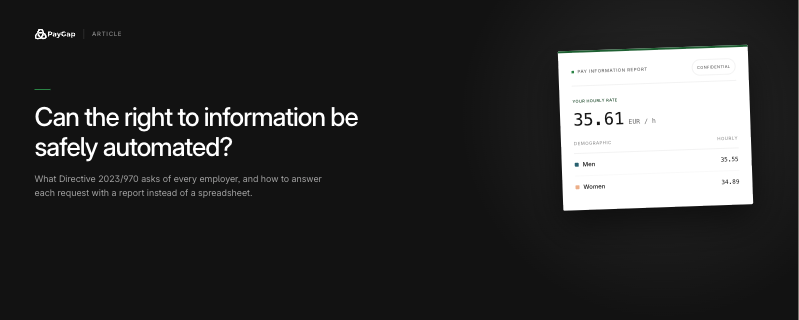
Alongside the employee's Pay Information report, PayGap can produce a separate manager report. This helps the reviewer understand how the employee's pay compares with the group, which documented factors were used to set the employee's pay and which payroll events may have contributed to the difference.
The employee-facing report can include an additional explanation page covering how the pay was calculated, how the category was selected, where differences may come from, the limitations of comparison with an average and the next steps available to the employee.
The two reports serve different purposes. The employee needs a clear, lawful and understandable answer. The manager or HRBP needs enough context to explain and review that answer without receiving unnecessary access to individual employee pay across the group.
Safe automation is a governance decision
The right to pay information should not become a recurring manual project for Reward and HR Operations. It also should not become an uncontrolled data-release mechanism.
The real standard is not whether a system can generate a report. It is whether the organisation can give every employee an answer that is accurate, explainable, confidential and on time, without rebuilding the process for every request and every country.
With the right data model, privacy controls and governance, the right to information can be automated safely. Without them, automation simply makes it possible to produce the wrong answer faster.